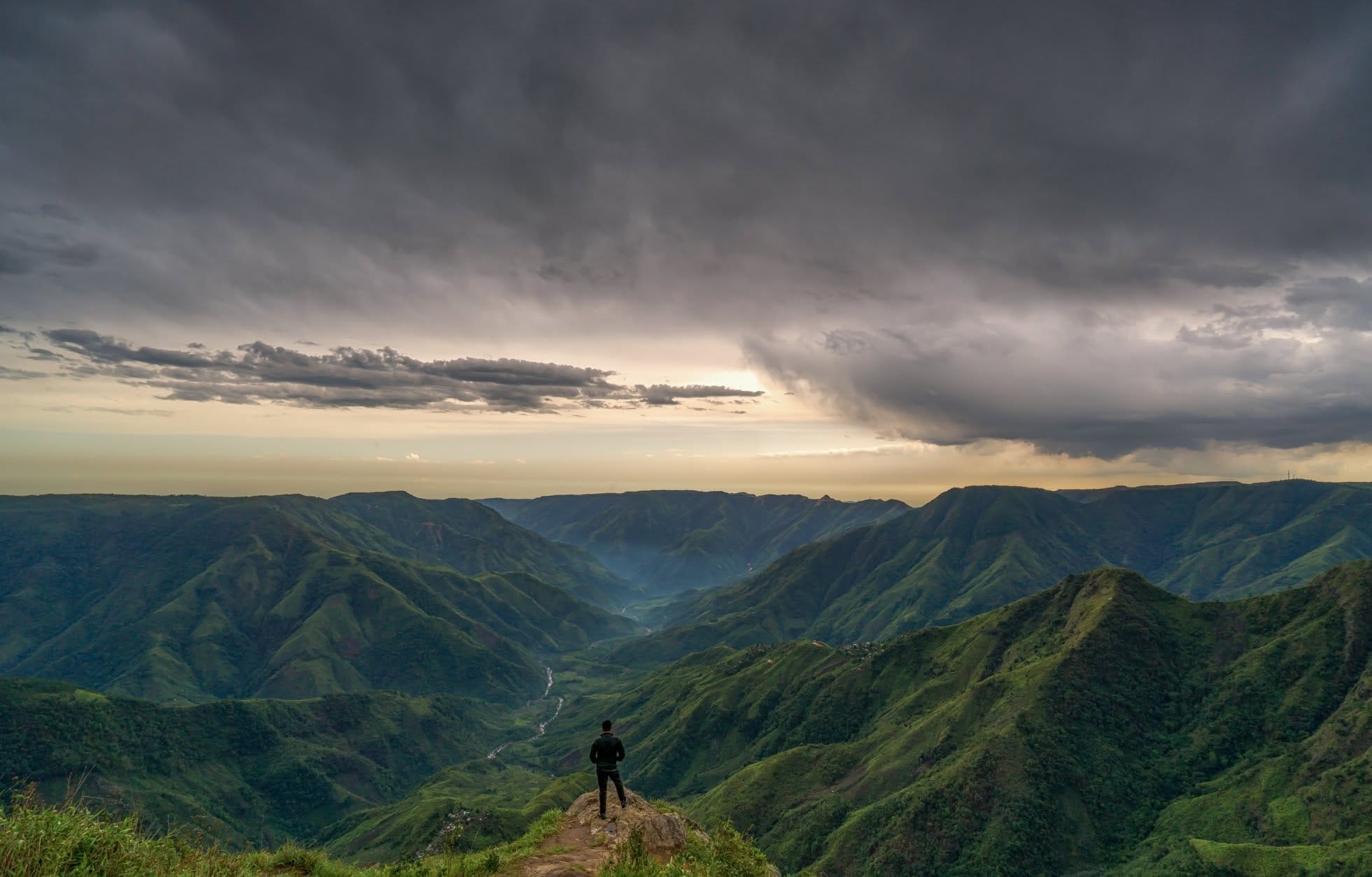
Meghalaya is not a destination that reveals itself in a single weekend. At first glance, the journey may seem to revolve around Shillong, Cherrapunji, Dawki and a few waterfalls. Stay longer, however, and a much broader side of Meghalaya begins to emerge. Stay longer, however, and a very different Meghalaya begins to emerge.
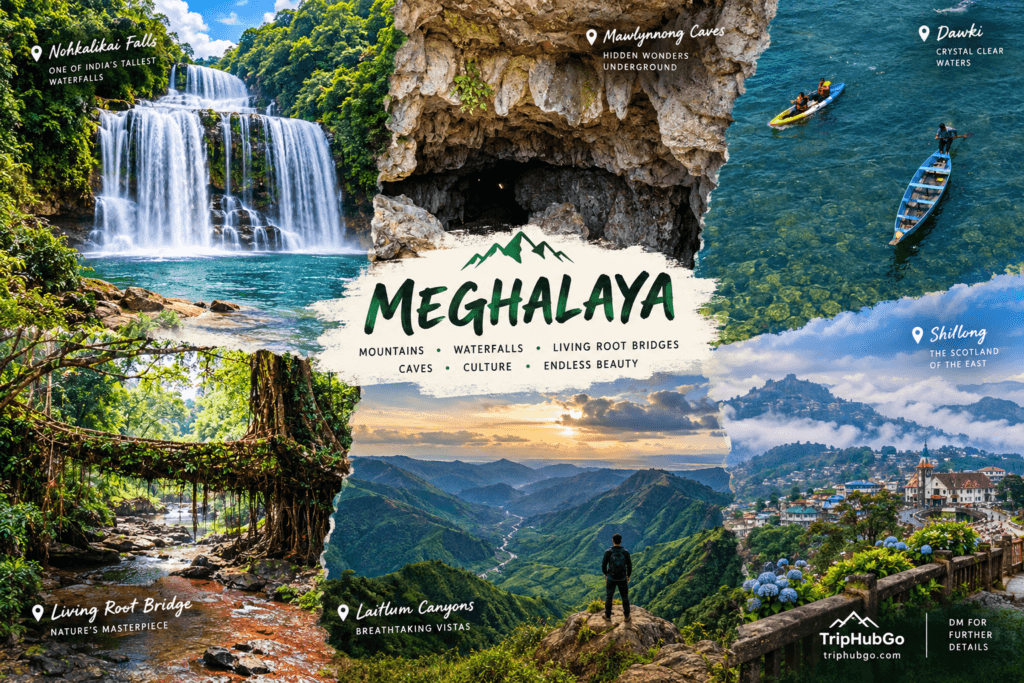
There are turquoise pools hidden below forested cliffs, villages connected by living root bridges, limestone caves disappearing beneath the hills, mist-covered valleys around Sohra, quiet lakes in the West Khasi Hills and long roads leading towards the comparatively unexplored landscapes of Garo Hills.
This is the Meghalaya that rewards travellers willing to slow down.
The state is home to three major hill regions — the Khasi Hills, Jaintia Hills and Garo Hills — and each has a distinct character.
For a first-time visitor, Shillong and Sohra provide the classic introduction. For returning travellers, Jowai, Phe Phe Falls, Krang Suri, Markham Valley, Nongkhnum and Mawryngkhang open another side of the state.
And then there is Garo Hills, where destinations such as Wari Chora and Siju turn a Meghalaya holiday into a genuine road adventure.
This guide brings these experiences together with practical information on Meghalaya weather, temperature, maps, transport, itineraries, waterfalls, accommodation and the best time to visit.
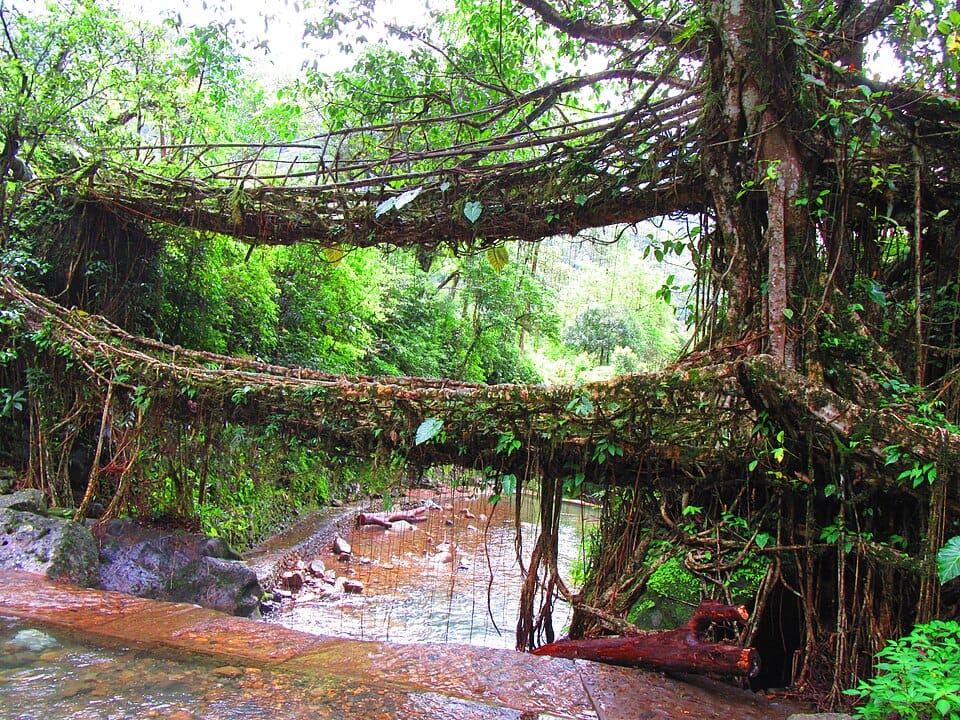
Table of Contents
- Meghalaya at a Glance
- What Makes Meghalaya Special?
- Meghalaya Capital, Geography & Regions
- Meghalaya Weather & Temperature
- Meghalaya Best Time to Visit
- Meghalaya Map & Tourist Circuits
- How to Reach Meghalaya
- Shillong Meghalaya
- Sohra and Cherrapunji
- Waterfalls in Meghalaya
- Phe Phe Falls
- Krang Suri Falls
- Jowai Meghalaya
- Dawki Meghalaya Tourist Places
- Markham Valley
- West Khasi Hills
- Meghalaya’s Caves
- Living Root Bridges
- Garo Hills
- Meghalaya Places at a Glance
- Meghalaya Itineraries
- Where to Stay
- Practical Travel Tips
- Frequently Asked Questions
- Author’s Verdict
Meghalaya at a Glance
| Information | Details |
|---|---|
| Capital | Shillong |
| Region | Northeast India |
| Major hill regions | Khasi Hills, Jaintia Hills, Garo Hills |
| Main gateway for most visitors | Guwahati Airport |
| Alternative airport | Shillong Airport (Umroi), with limited flight connectivity |
| Famous for | Waterfalls, caves, living root bridges, rivers, forests and hills |
| Popular destinations | Shillong, Sohra, Dawki, Jowai, Mawlynnong and Nongriat |
| Best general travel period | October–April |
| Best waterfall experience | Monsoon and post-monsoon |
| Best trekking period | October–April |
| Recommended first trip | 5–7 days |
| Extended Meghalaya trip | 8–12 days |
What Makes Meghalaya Special?
There are many beautiful hill destinations in India, but Meghalaya stands apart for its close connection between nature and everyday life. Waterfalls, sacred forests, living root bridges and community-based tourism are all part of the landscape.
Meghalaya Tourism promotes experiences including waterfalls, caves, living root bridges, village experiences, trekking and river activities.
With such diversity, a Meghalaya itinerary is best planned geographically rather than simply by popularity.
Meghalaya Capital, Geography & Regions
Shillong is the capital of Meghalaya and a convenient base for exploring the state’s surrounding hills, waterfalls, caves, forests and rivers. For travel planning, Meghalaya can be understood through four broad zones.
| Region | Character | Best For | Key Destinations |
|---|---|---|---|
01
Shillong & Surrounding Khasi Hills Central Meghalaya | The state’s principal urban centre and a convenient base for exploring nearby hills and viewpoints. | Shillong
Umiam Lake
Laitlum
Mawphlang | |
02
Sohra & East Khasi Hills Waterfalls & rainforest | A landscape of waterfalls, caves, cliffs, living root bridges and rainforest scenery. | Sohra
Nohkalikai Falls
Mawsmai Cave
Living Root Bridges | |
03
Jaintia Hills
Eastern Meghalaya | An eastern travel zone known for waterfalls, rivers, heritage sites and scenic destinations. | Jowai
Phe Phe Falls
Krang Suri
Dawki
Shnongpdeng
Nartiang | |
04
West Khasi & Garo Hills Western Meghalaya | A wider western zone with quieter landscapes, valleys, caves, forests and offbeat destinations. | Mawphanlur
Markham Valley
Nongkhnum
Wari Chora
Siju
Balpakram |
Located in the Khasi Hills, Shillong is the state’s principal urban centre and one of the most convenient bases for exploring the surrounding region.
Meghalaya Weather & Temperature
The Meghalaya weather changes considerably according to season, elevation and location. Shillong can feel cool and crisp, while lower areas and Garo Hills can be considerably warmer. Sohra, meanwhile, has an entirely different reputation because of its extraordinary rainfall.
Meghalaya Temperature by Season
Meghalaya experiences distinct seasonal changes, from pleasant spring conditions and heavy monsoon rainfall to cooler and drier winter mornings.
| Season | Typical Travel Conditions | What to Expect |
|---|---|---|
March–April
Spring | Pleasant | Spring weather with occasional showers. |
May–September
Monsoon | Wet | Heavy rainfall and powerful waterfalls. |
October–November
Post-monsoon | Pleasant | Green landscapes and clearing skies. |
December–February
Winter | Cool / Dry | Clearer skies and colder mornings. |
Shillong Weather
Shillong has cooler weather than Assam’s plains, with cold winters, pleasant summers and rapidly changing conditions during the rainy season.
If you are checking a Shillong weather forecast before departure, don’t look only at temperature. Check:
- rainfall
- thunderstorms
- road conditions
- visibility
- landslide warnings
This is particularly important if your itinerary includes Sohra or remote waterfall trails.
Meghalaya Best Time to Visit
The best time to visit Meghalaya depends on the experience you want — from comfortable sightseeing and clear skies to dramatic waterfalls during the monsoon.
| Season | Travel Conditions | Best For | What to Expect |
|---|---|---|---|
October – November
Post-monsoon | Pleasant | The landscape remains green after the monsoon, waterfalls can still be impressive and outdoor conditions generally become easier. | |
December – February
Cool & dry | Cool | Clearer skies and generally suitable conditions for outdoor activities. Temperatures can be cold, particularly at night. | |
March – April
Spring transition | Pleasant | A pleasant transition period with greenery, comfortable sightseeing conditions and occasional pre-monsoon showers. | |
May – September
Monsoon | Heavy Rain | Waterfalls and rivers can become spectacular, but heavy rainfall can affect roads, trails and outdoor activities. |
A practical period for a balanced Meghalaya trip, with generally easier conditions for sightseeing, road travel and outdoor activities.
Consider this period if you are comfortable with heavy rain and changing travel conditions.
Planning tip: Meghalaya’s weather varies by season and location. Check local weather and road conditions before travelling, particularly during the monsoon.
Meghalaya Map & Tourist Circuits
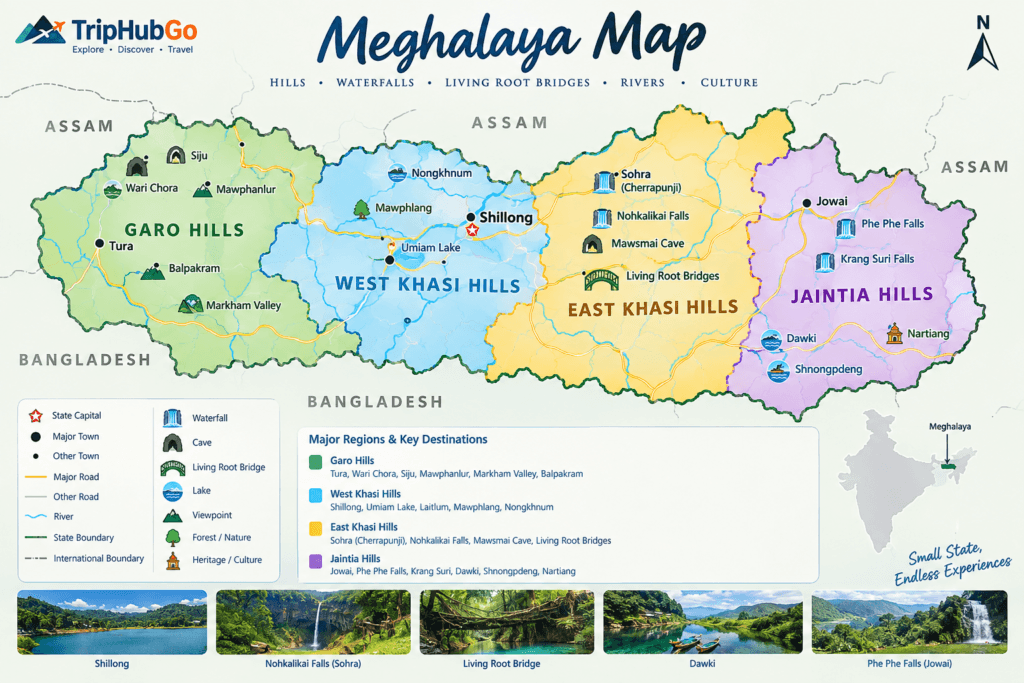
A Meghalaya map makes one thing immediately obvious: trying to visit every major attraction from one hotel can create unnecessarily long drives.
Instead, divide the journey into circuits.
Meghalaya Travel Circuits
Choose a Meghalaya travel circuit based on your available time, interests and the regions you want to explore.
| Circuit | Route | Ideal For |
|---|---|---|
01
Classic Meghalaya
First-time route | Guwahati
→
Shillong
→
Sohra
→
Mawlynnong
→
Dawki
→
Shillong / Guwahati | First-time visitors |
02
Jaintia Hills
Waterfall circuit | Shillong
→
Jowai
→
Phe Phe
→
Krang Suri
→
Nartiang
→
Dawki | Waterfall lovers & returning travellers |
03
West Khasi Hills
Slow travel route | Shillong
→
Mawphanlur
→
Markham Valley
→
Nongkhnum | Slow travel & photography |
04
Garo Hills
Longer adventure | Shillong / Guwahati
→
Tura
→
Wari Chora
→
Siju
→
Balpakram | Travellers with more time |
Don’t underestimate road travel in Meghalaya. A relatively short distance on the map can take considerably longer on winding hill roads.
How to Reach Meghalaya?
For most travellers, Guwahati is the main gateway to Meghalaya, with Shillong easily accessible by road.
| Travel Option | Starting Point | Route / Connection | Travel Information |
|---|---|---|---|
By Air
Most convenient gateway | Guwahati Airport | Guwahati Airport → Shillong | For most visitors, Guwahati Airport is the practical gateway to Meghalaya. From the airport, continue by road towards Shillong. |
By Train
Rail gateway | Guwahati Railway Station | Guwahati Railway Station → Shillong | There is no major railway connection serving Shillong in the same way that Guwahati does. Most rail travellers therefore continue from Guwahati Railway Station to Shillong by road. |
Bus & Shared Taxi
Road transport | Guwahati | Guwahati → Shillong Selected services also connect Shillong with Sohra and Dawki | Shared taxis and buses connect Guwahati and Shillong. Meghalaya Tourism also operates guided bus services on selected routes, including Shillong–Sohra and Shillong–Dawki. Check current schedules and availability before travelling. |
Guwahati–Shillong
Road distance | Guwahati | Guwahati → Shillong | The Shillong distance from Guwahati is roughly 100 km by road. Actual journey time can vary depending on traffic, weather and road conditions. |
Travel tip: If you are arriving in Northeast India by air or train, Guwahati is a practical starting point for continuing towards Shillong and other parts of Meghalaya.
Shillong Meghalaya
Shillong is where many Meghalaya journeys begin.
It is not merely a transit point.
The city combines:
- hill scenery
- markets
- cafés
- museums
- viewpoints
- parks
- music culture
- Khasi heritage
Places to Visit in Shillong
Ward’s Lake
A peaceful city lake surrounded by landscaped gardens.
Police Bazaar
Shillong’s busiest commercial district and a convenient place for food and shopping.
Don Bosco Museum
A useful introduction to the indigenous cultures and communities of Northeast India.
Shillong Peak
One of the city’s best-known viewpoints. Meghalaya Tourism places Shillong Peak around 10 km from central Shillong and recommends clearer months from September/October through March for visibility.
Shillong Elephant Falls
Elephant Falls Shillong is among the easiest waterfalls to visit around the city.
It is therefore particularly useful for:
- first-time visitors
- families
- short itineraries
- travellers who cannot fit a full waterfall circuit into their schedule
Unlike remote waterfalls that require lengthy hikes, Elephant Falls can be incorporated into a half-day Shillong sightseeing plan.
Umiam Lake
Umiam Lake lies north of Shillong and is one of the most recognisable landscapes around the city. It works particularly well as an arrival or departure stop because it is located along the Guwahati–Shillong route.
Laitlum Canyon
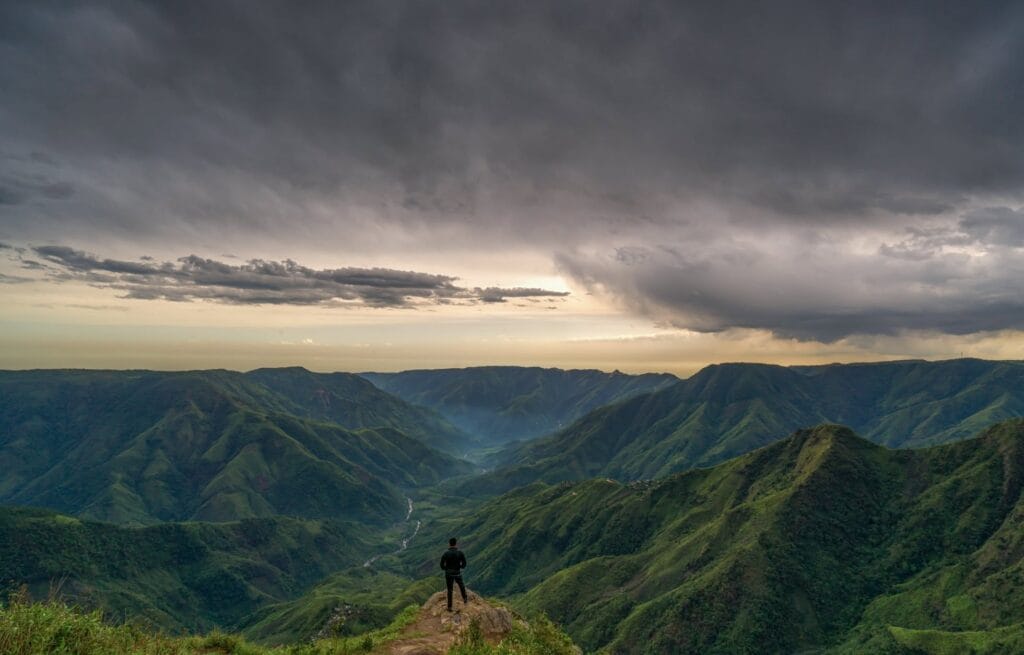
For travellers who prefer viewpoints to city sightseeing, Laitlum is an excellent addition. The landscape opens into deep valleys and layered hills, making it particularly attractive in clear weather.
Sohra and Cherrapunji
One of the most common questions is:
Is Sohra the same as Cherrapunji?
For travel purposes, yes — Sohra is the local name commonly used for the town historically known as Cherrapunji. You’ll therefore see both terms used online:
- Sohra
- Cherrapunji
- Cherrapunjee
This is important when searching for accommodation, maps or transport.
Cherrapunji City or Sohra?
If you search for Cherrapunji city, you’re essentially looking at the urban centre of Sohra and its surrounding tourist region. But don’t expect a large conventional city. The real attraction is the landscape around it.
From Sohra, you can reach:
- Nohkalikai Falls
- Seven Sisters Falls
- Mawsmai Cave
- Dainthlen Falls
- Kynrem Falls
- Wei Sawdong
- Prut Waterfall
- living root bridges
- viewpoints and valleys
Meghalaya Tourism places Sohra around 53 km from Shillong and highlights its waterfalls, caves and living root bridges.
Cherrapunji from Guwahati
The road journey from Cherrapunji from Guwahati is considerably longer than the Shillong–Sohra drive. For most travellers, the logical route is:
Guwahati → Shillong → Sohra
Rather than attempting to treat Cherrapunji as a quick excursion from Guwahati, stay overnight in Sohra. This gives you much more time for waterfalls and caves.
Cherrapunjee Homestay: Should You Stay Locally?
Yes.
A Cherrapunjee homestay can be a better fit than returning to Shillong every evening.
The advantages include:
- shorter sightseeing drives
- early starts
- local food
- village atmosphere
- easier access to waterfalls
- more time in Sohra
If you plan to stay in Sohra, choosing a local homestay can reduce daily driving and give youMeghalaya is not a destination that reveals itself in a single weekend. more time for waterfalls, caves and nearby villages.
Waterfalls in Meghalaya
If one attraction defines Meghalaya tourism, it is the waterfall. But there is a difference between seeing one famous waterfall and actually experiencing Meghalaya’s waterfall country. The state has everything from giant plunge falls to small cascades hidden behind forests.
Seven Sister Waterfall
The Seven Sister Waterfall, officially known as Nohsngithiang Falls, is one of the most recognisable waterfalls in Meghalaya. The falls descend over the southern escarpment in multiple streams. It is best viewed from designated viewpoints rather than approached as a conventional trekking waterfall. Meghalaya Tourism recommends combining it with stops such as Sohra Eco Park, Mawkdok, Mawsmai Cave, Nohkalikai and Khoh Ramhah.
Best experience
Visit in the monsoon or immediately afterwards when water flow is stronger.
Nohkalikai Falls
At approximately 340 metres, Nohkalikai is one of the great waterfall viewpoints of India. Unlike a waterfall that you approach at ground level, Nohkalikai is best appreciated from the viewpoint overlooking the plunge. It should be one of the first stops on any Sohra itinerary.
Dainthlen Falls
Dainthlen is one of the waterfalls where geography and folklore come together. The name is associated with the Khasi legend of Thlen, a mythical serpent. The waterfall is easily combined with the wider Sohra circuit.
Kynrem Falls
Kynrem is another major waterfall in the Sohra region. It is associated with the Thangkharang area and becomes particularly impressive during and after the rains. Meghalaya Tourism currently features Kynrem Falls among the state’s principal attractions.
Weisawdong Falls
Weisawdong is a striking three-tier waterfall known for its turquoise pools and steep forested setting. However, this is one place where travellers should check current local access conditions immediately before visiting. There have been administrative disputes and temporary restrictions concerning access in 2026, even though restrictions were later lifted in July. More importantly, Meghalaya authorities have issued safety advisories following accidents around waterfalls and river areas.
So: Never stand close to waterfall edges simply to capture a photograph. The attraction is beautiful. The rocks and currents can be unforgiving.
Prut Waterfall
Prut Waterfall is one of the more interesting additions to a Sohra itinerary because of its distinctive setting and the possibility of approaching the area behind the falling water.
Current travel references place it around the Laitlyndop area near Sohra, although visitors should confirm local access and conditions before travelling.
Janailar Falls
Janailar Falls is another lesser-known waterfall around the Sohra/Laitlyndop area.
Unlike some obscure attractions for which there is almost no supporting information, Janailar is now documented in tourism-development material that lists parking, shops, toilets and community management. That makes it reasonable to include in a broader Meghalaya waterfall guide. However, because facilities and access can change, confirm current conditions locally.
Other Waterfalls Worth Adding
If you have additional time, consider:
- Mawsawdong Falls
- Lyngksiar Falls
- Mawsawa Falls
- Garden of Caves waterfalls
- Langshiang Falls
- Weinia Falls
- Elephant Falls
- Phe Phe Falls
- Krang Suri Falls
This is where Meghalaya becomes interesting: the famous waterfalls are only the beginning.
Phe Phe Falls
Phe Phe Falls is one of the places I would specifically recommend adding to a Jaintia Hills itinerary. The waterfall is approximately 85 km from Shillong and about 22 km from Jowai. The final approach includes a short hike from the parking area near Shkentalang. The name is associated with the Khasi word for paradise-like surroundings, and the landscape certainly fits the description.
Expect:
- two waterfall tiers
- turquoise pools
- bamboo groves
- forest trails
- quieter surroundings
The official tourism information recommends October to April for safer trekking and clearer water views.
Krang Suri Falls
If Phe Phe feels hidden, Krang Suri feels cinematic.
The waterfall is approximately 91 km from Shillong and around 30 minutes from Jowai according to Meghalaya Tourism.
Its striking blue-green pool is the reason many visitors put it high on their Jaintia Hills itinerary.
The site includes a descent trail and a natural pool, with life jackets available for visitors using the water.
Best time
Meghalaya Tourism recommends October to May for pleasant weather and clearer blue water.
Jowai Meghalaya
Shillong is Meghalaya’s urban gateway, Sohra is one of the state’s main bases for exploring waterfalls, caves and surrounding landscapes, while Jowai is an excellent base for discovering the waterfalls, rivers and cultural attractions of the Jaintia Hills.
The town itself is not the only reason to visit.
It is the gateway to:
- Phe Phe Falls
- Krang Suri
- Nartiang
- Ialong
- Thadlaskein
- Dawki
- several lesser-known waterfalls
Jowai Weather
Jowai weather is generally warmer than Shillong’s because of differences in elevation and geography.
For outdoor attractions, however, rainfall is more important than temperature.
Before travelling from Jowai to a waterfall, check:
- rain forecast
- road conditions
- waterfall access
- local restrictions
Jowai Places to Visit
Nartiang Monoliths
Nartiang combines religious history with Meghalaya’s megalithic traditions.
Ialong Nature Park
A scenic stop near Jowai offering valley views.
Thadlaskein Lake
A quieter landscape that works well as part of a wider Jowai itinerary.
Jowai Circuit Waterfalls vs Sohra Waterfalls
Both areas offer spectacular waterfalls, but the experience is different. The Jowai circuit combines Phe Phe and Krang Suri, while Sohra offers a more established waterfall circuit.
| Feature | Jowai Circuit Phe Phe + Krang Suri | Sohra Waterfalls East Khasi Hills |
|---|---|---|
| Region | Jaintia Hills | East Khasi Hills |
| Main Highlights | Phe Phe Falls
Krang Suri Falls | Nohkalikai
Seven Sisters
Wei Sawdong
Other Sohra waterfalls |
| Atmosphere | More offbeat and relatively quieter | More popular and established |
| Water Experience | Turquoise pools, cascades and swimming-oriented scenery | Dramatic cascades, cliffs and large waterfall viewpoints |
| Trekking | Short to moderate walks depending on the waterfall | Varies from viewpoints to longer walks and treks |
| Best For | Offbeat travellers Waterfall lovers Returning visitors | First-time visitors |
| Ideal Base | Jowai | Sohra (Cherrapunji) |
| Travel Style | Explore multiple waterfalls around the Jowai circuit | Concentrated waterfall and nature sightseeing around Sohra |
| Choose This If… |
You want an offbeat route
Choose the Jowai circuit if you want to combine Phe Phe and Krang Suri and explore a less conventional waterfall route. |
You want the classic Meghalaya experience
Choose Sohra if you want to experience Meghalaya’s iconic waterfall landscapes through an established sightseeing circuit. |
Dawki Meghalaya Tourist Places
Dawki is one of Meghalaya’s most photographed destinations because of the Umngot River and its proximity to the Bangladesh border.
But Dawki is more than a photograph of clear water.
The surrounding region includes:
- Shnongpdeng
- Darrang
- Umngot River
- suspension bridge
- riverside camps
- kayaking
- boating
- adventure activities
Meghalaya Tourism places Dawki in West Jaintia Hills and lists Shillong and Jowai as the principal road approaches.
Cherrapunji to Dawki Distance
The Cherrapunji to Dawki distance is commonly quoted differently depending on the exact route and starting point. For planning purposes, allow several hours rather than treating it as a quick transfer.
A practical route is:
Sohra → Mawlynnong → Dawki/Shnongpdeng
This is why many travellers combine the two regions in the same itinerary.
Shnongpdeng
If Dawki is your sightseeing stop, Shnongpdeng is your overnight river experience.
Activities can include:
- kayaking
- boating
- camping
- ziplining
- snorkelling
- other water-based activities
Meghalaya Tourism describes Shnongpdeng as a riverside adventure base along the Umngot and recommends it for outdoor activities.
Dawki Hotels and Accommodation
Travellers searching for Dawki hotels should also consider camps and homestays around Shnongpdeng. Accommodation is not limited to conventional hotels. For a nature-focused trip, consider:
Dawki → Shnongpdeng overnight
rather than returning immediately to Shillong.
Markham Valley
Markham Valley belongs to a quieter Meghalaya.
The landscape is defined less by famous tourist attractions and more by:
- rolling hills
- paddy fields
- clouds
- villages
- viewpoints
- open landscapes
Meghalaya Tourism currently promotes a two-day West Khasi Hills route connecting Mawphanlur, Markham, Mawlai Syiem and Mawkynrum. This is a strong option for photographers and travellers who have already completed the classic Shillong–Sohra–Dawki circuit.
Markham Valley View Point
The Markham Valley view point is best approached as part of a broader West Khasi Hills road trip rather than a standalone attraction. The appeal is the panorama itself: hills, agricultural landscapes and clouds rolling through the valleys. For the best experience, allow time rather than rushing in, taking a photograph and immediately leaving.
West Khasi Hills
If you want Meghalaya without the feeling of following a tourist checklist, head west.
Mawphanlur
A landscape of rolling hills and small lakes.
Ideal for:
- camping
- photography
- couples
- slow travel
- peaceful stays
Nongkhnum River Island
Nongkhnum is one of Meghalaya’s most unusual landscapes. The Kynshi River divides around the island, creating river beaches, grasslands and a landscape that feels remarkably different from Sohra.
Weinia Falls
A waterfall that can be combined with a wider Nongkhnum journey.
Mawryngkhang Bamboo Trek
For adventure travellers, the Mawryngkhang Bamboo Trek is one of Meghalaya’s signature experiences. The route uses bamboo structures and trails along steep terrain. It is not the right choice for everyone.
You should be comfortable with:
- heights
- narrow sections
- uneven ground
- walking for several hours
Lumer Pynggad / Lum Er Pynggad
Lumer Pynggad has gained attention as a convenient short-trip destination from Guwahati, particularly for travellers looking for a Meghalaya experience without going deep into Shillong. Its relatively shorter approach makes it suitable for a one-day trip, while avoiding the need to drive through Shillong’s often-busy traffic.
Meghalaya’s Caves
Meghalaya is one of India’s most important cave regions.
The limestone landscape has produced extensive underground systems.
Mawsmai Cave
The easiest introduction to Meghalaya’s cave world.
Arwah Cave
More atmospheric and exploratory, with limestone formations and fossil-related features.
Krem Mawmluh
A more serious cave environment.
Krem Puri
Known for its enormous underground passages.
Krem Liat Prah
A destination for experienced cavers rather than casual tourists.
Siju Cave
One of Garo Hills’ most important cave destinations.
Meghalaya Cave Comparison
Meghalaya offers caves ranging from relatively easy visits for beginners to challenging underground experiences for experienced cavers.
| Cave | Suitable For | Experience |
|---|---|---|
01
Mawsmai | Beginners | Easy |
02
Arwah | Explorers | Moderate |
03
Krem Mawmluh | Experienced visitors | Difficult |
04
Krem Puri | Serious caving | Difficult |
05
Krem Liat Prah | Experienced cavers | Advanced |
06
Siju | Adventure travellers | Moderate–Difficult |
Never enter technically challenging caves without appropriate equipment and experienced local guidance.
Living Root Bridges
Perhaps nothing illustrates Meghalaya’s relationship with nature better than the living root bridges. The most famous is the Nongriat Double-Decker Living Root Bridge. The route from Tyrna involves thousands of steps and should be treated as a proper trek rather than a sightseeing excursion. The living root bridges are created by guiding the roots of rubber fig trees until they form usable natural crossings. That means the bridge is not merely old.
It is alive.
Mawlynnong
Mawlynnong became famous internationally for its cleanliness and village tourism.
Today, the attraction is broader:
- village life
- Riwai Living Root Bridge
- viewpoints
- community tourism
- surrounding countryside
Visit respectfully.
This is a living village, not an open-air museum.
Garo Hills
The further west you travel, the more Meghalaya changes. Garo Hills is less about ticking off attractions and more about wilderness, rivers, caves and long road journeys.
Wari Chora
Wari Chora is a dramatic river canyon in South Garo Hills, best suited for travellers with extra time. The journey is long, but Meghalaya Tourism recommends local guidance for the experience.
Meghalaya Places at a Glance
A quick overview of Meghalaya’s popular destinations, their regions, main attractions and the time you may want to allow for each stop.
| Place | Region | Main Reason to Visit | Suggested Time |
|---|---|---|---|
01Shillong | Khasi Hills | City, culture | 1–2 days |
02Umiam | Ri-Bhoi | Lake | Half day |
03Laitlum | East Khasi Hills | Canyon | Half day |
04Sohra | East Khasi Hills | Waterfalls & caves | 2 days |
05Nongriat | East Khasi Hills | Root bridge | 1 day |
06Mawlynnong | Khasi Hills | Village & root bridge | Half / 1 day |
07Dawki | Jaintia Hills | Umngot | 1 day |
08Shnongpdeng | Jaintia Hills | River activities | 1 night |
09Jowai | Jaintia Hills | Base for attractions | 1–2 days |
10Phe Phe | Jaintia Hills | Waterfall | Half day |
11Krang Suri | Jaintia Hills | Blue pool | Half day |
12Nartiang | Jaintia Hills | History | Half day |
13Mawphanlur | West Khasi Hills | Lakes & hills | 1–2 days |
14Markham Valley | West Khasi Hills | Landscapes | Half / 1 day |
15Nongkhnum | West Khasi Hills | River island | 1–2 days |
16Wari Chora | Garo Hills | River canyon | 2–3 days |
Meghalaya Falls: Which Ones Should You Visit?
If you have only three days, don’t attempt everything.
For first-time visitors
Choose:
Nohkalikai + Seven Sisters + Dainthlen
For waterfall enthusiasts
Add:
Kynrem + Wei Sawdong + Prut
For something different
Go to:
Phe Phe + Krang Suri
For serious offbeat travel
Explore:
Janailar + Mawsawa + Lyngksiar + Mawsawdong
5-Day Meghalaya Itinerary
If you have less time, see our 3-day Meghalaya itinerary for a shorter route covering the key highlights.
A balanced five-day route covering Shillong, Sohra, Mawlynnong, Dawki and Shnongpdeng.
Guwahati to Shillong
Begin your Meghalaya journey from Guwahati and continue towards Shillong, with a stop at Umiam Lake before checking in.
Explore Shillong
Spend the day exploring Shillong’s viewpoints, waterfalls, museums and surrounding landscapes.
Shillong to Sohra
Travel towards Sohra through scenic hill roads and explore some of the area’s best-known viewpoints, caves and waterfalls.
Sohra to Dawki
Continue towards the southern and eastern parts of Meghalaya, visiting Mawlynnong, the Riwai Root Bridge and the Dawki–Shnongpdeng area.
Shnongpdeng → Shillong / Guwahati
Complete the Meghalaya journey with your return transfer from Shnongpdeng towards Shillong or Guwahati.
Road travel can take longer than expected in Meghalaya because of winding hill roads, weather and traffic. Keep some flexibility in your daily schedule rather than planning every stop too tightly.
Travelling with less time? Our 3-day Meghalaya itinerary offers a shorter alternative for a quick trip.
7-Day Meghalaya Itinerary
A seven-day route combining Shillong, Sohra, Mawlynnong, Dawki and the Jowai circuit for a more varied Meghalaya experience.
Guwahati → Shillong
Shillong + Laitlum
Shillong → Sohra
Sohra Waterfalls + Caves
Sohra → Mawlynnong → Dawki
Dawki → Jowai → Phe Phe → Krang Suri
Jowai → Shillong / Guwahati
This seven-day route gives you considerably more variety than spending all seven days around Shillong, combining the Khasi, Sohra and Jaintia Hills circuits.
Now lets check the 10 day Itinerary
10-Day Meghalaya Itinerary
A longer Meghalaya route covering Shillong, Sohra, Nongriat, Mawlynnong, Dawki, Jowai, West Khasi Hills and Nongkhnum.
Guwahati → Shillong
Shillong
Shillong → Sohra
Sohra Waterfalls
Nongriat
Mawlynnong → Dawki
Shnongpdeng
Jowai → Phe Phe → Krang Suri
Jowai → Mawphanlur / Markham Valley
Nongkhnum → Shillong / Guwahati
Allow 3–4 additional days
For Garo Hills, it is better to add at least 3–4 additional days rather than trying to squeeze Wari Chora into this itinerary.
Planning note: This western Meghalaya section involves longer road journeys. If you want to explore Mawphanlur, Markham Valley and Nongkhnum at a relaxed pace, consider adding an extra night.
Where to Stay in Meghalaya
Shillong
Best for:
- first-time visitors
- families
- restaurants
- shopping
- easy transport
Sohra
Best for:
- waterfalls
- caves
- Nongriat
- early starts
Search terms such as Cherrapunjee homestay are particularly useful if you want a local experience rather than a conventional hotel.
Dawki/Shnongpdeng
Best for:
- river activities
- camping
- couples
- adventure travellers
Jowai
Best for:
- Phe Phe
- Krang Suri
- Nartiang
- Jaintia Hills
Mawphanlur
Best for:
- slow travel
- nature
- camping
- photography
Practical Meghalaya Travel Tips
1. Carry waterproof clothing
Rain can arrive unexpectedly. A waterproof jacket is more useful than relying only on an umbrella.
2. Wear proper footwear
Waterfalls and trails become extremely slippery.
3. Don’t underestimate road time
Meghalaya is a mountain destination. Distances on Google Maps do not always translate into quick journeys.
4. Carry cash
Remote destinations may have limited payment connectivity.
5. Download offline maps
Mobile network coverage can be unreliable in remote areas.
6. Start early
This is especially important for:
- waterfalls
- Dawki
- Nongriat
- Jowai
- long-distance transfers
7. Don’t go too close to waterfall edges
This deserves special emphasis. Meghalaya’s waterfalls can look calm while carrying extremely strong currents. Recent official safety advisories have highlighted risks around waterfall and river areas, including Weisawdong.
Frequently Asked Questions
What is the Meghalaya capital?
Shillong is the capital of Meghalaya.
What is Meghalaya famous for?
Meghalaya is particularly known for:
- waterfalls
- caves
- living root bridges
- mountains
- rivers
- forests
- Khasi, Jaintia and Garo culture
What is the best time to visit Meghalaya?
For a balanced trip, October to April is a practical choice.
For dramatic waterfalls, the monsoon can be spectacular, but travel conditions are more challenging.
How far is Shillong from Guwahati?
Shillong is roughly 100 km from Guwahati by road, although journey time varies with traffic and conditions.
Is Sohra the same as Cherrapunji?
Yes. Sohra is the local name associated with Cherrapunji.
Both names are commonly used by travellers and tourism businesses.
What are the best waterfalls in Meghalaya?
Some of the most notable are:
- Nohkalikai
- Seven Sisters
- Dainthlen
- Kynrem
- Wei Sawdong
- Prut
- Phe Phe
- Krang Suri
- Janailar
Is Phe Phe Falls worth visiting?
Yes, particularly if you are exploring Jowai and the Jaintia Hills.
It offers a quieter experience than many of the famous Sohra waterfalls.
Is Krang Suri worth visiting?
Krang Suri is particularly known for its blue-green plunge pool and forested setting.
It works well as part of a Jowai itinerary.
What is the best Meghalaya itinerary for seven days?
A balanced seven-day route is:
Guwahati → Shillong → Sohra → Mawlynnong → Dawki/Shnongpdeng → Jowai → Phe Phe/Krang Suri → Shillong/Guwahati
Is Meghalaya suitable for families?
Yes, provided the itinerary is adjusted for mobility.
Shillong, Sohra viewpoints, Mawlynnong and Dawki are easier than demanding hikes such as Nongriat or Mawryngkhang.
Should I stay in Shillong or Cherrapunji?
For a first trip, stay in both if possible.
Shillong: city, culture and easier access.
Sohra: waterfalls, caves and nature.
How many days are enough for Meghalaya?
5 days: classic Meghalaya.
7 days: classic + Jaintia Hills.
10 days: classic + Jaintia + West Khasi Hills.
12–14+ days: consider Garo Hills.
| Destination | Best For | Recommended For |
|---|---|---|
| Shillong | City, culture & viewpoints | First-time visitors, short stays |
| Sohra | Waterfalls, caves & rainforest | Nature lovers, first-time Meghalaya travellers |
| Jowai | Offbeat waterfalls & quieter landscapes | Repeat visitors, offbeat travellers |
How I Would Plan a Meghalaya Trip
For a first Meghalaya trip, I would keep the route focused on Shillong, Sohra and the Jaintia Hills, rather than trying to cover the entire state in a few days. A 5–7 day itinerary works well for the main highlights, while 8–12 days gives you more time for quieter areas such as West Khasi Hills and Jowai.
If you want to include Garo Hills, Wari Chora or other offbeat destinations, it is better to add extra days rather than rushing through long hill-road journeys.
Want us to plan your Meghalaya trip?
Tell us your travel dates, number of travellers, preferred duration and budget, and TripHubGo can help you plan a route around the places you actually want to experience.re Meghalaya becomes memorable.
Ready to explore Meghalaya?
Tell us your travel dates, number of travellers, duration and budget. We’ll help you plan a Meghalaya itinerary around your interests.
Plan My Meghalaya Trip →